____________________
(former Ildiko Dobranyi Foundation)
|
|
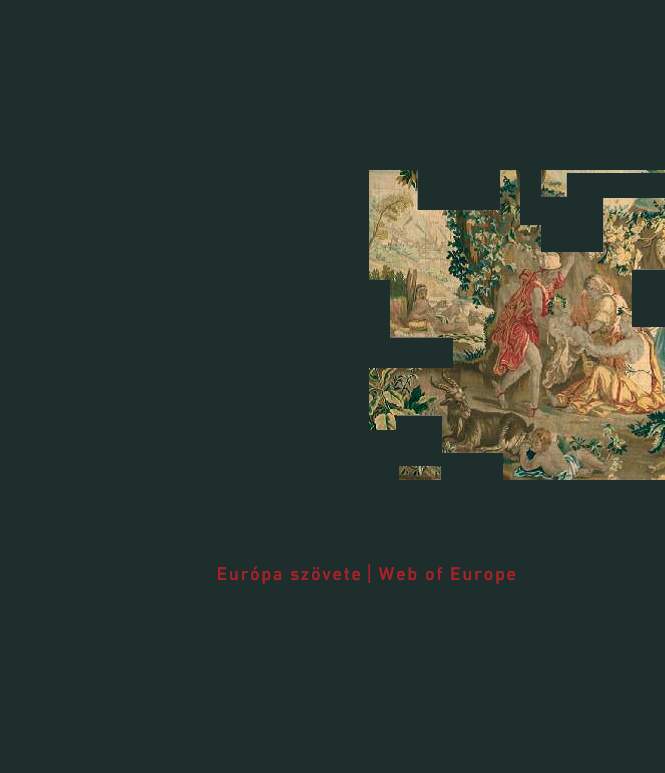
| Web of Europe / Contemporary paraphrases of an eighteenth-century Brussels tapestry | |
|
Editors: Ibolya Hegyi, Katalin Schulcz Authors: Edit Andras, Ibolya Hegyi, Miklos Mojzer, Katalin Schulcz, Reka Semsey, Imre Takacs Translation: Kathy Mikitin, Chris Sullivan Design: Johanna Bard Photographs: Philip Donner, UNICO ARTE BT Editor-in-Chief: Imre Takacs, Director-general Museum of Applied Arts, Budapest Miklos Mojzer, President of the Ildikó Dobrányi Foundation Print: Mester Nyomda Kft ISBN 978-963-08-1101-9 |
|
| A creative process based on known European tapestry artists, this project was launched by the Budapest-based Ildikó Dobrányi Foundation in conjunction with the Hungarian Cultural Institute in Brussels. As a result of it, the work Web of Europe, an unusual, jointly woven tapestry from the twentieth-first century, has been made for the period of Hungary's presidency of the European Union, namely for the first six months of 2011. The work will be on display to the general public at the Musées Royaux d'Art et d'Histoire in Brussels from 20 May until 14 August 2011 and later on, in the autumn of 2011, at the Museum of Applied Arts in Budapest. It has never been a secret that the intention of this initiative is to direct attention, on a European scale, to the art of woven tapestry, which is not simply a part of our common European heritage meriting esteem and preservation, but also, simultaneously, a living, inspirational cultural medium, an exciting genre of contemporary art capable of ongoing renewal. | |
| The basis for this collective composition was the eighteenth-century Brussels tapestry Mercury Hands over the Infant Bacchus to the Nymphs which is kept at the Museum of Applied Arts in Budapest and was cut out virtually and reinterpreted and re-weaved by twenty-seven artists: Maria Almanza (Belgium), Wanda Balogh (Hungary), Anet Brusgaard (Denmark), Nora Chalmet (Belgium), Paola Cicuttini (Belgium), Gabriela Cristu Sgarbura (Romania), Muriel Crochet (France), Thomas Cronenberg (Germany), Adel Czegledi (Hungary), Wlodzimierz Czygan (Poland), Emese Csokas (Hungary), Ariadna Donner (Finland), Emőke (France), Martine Ghuys (Belgium), Peter Horn (Germany), Anne Jackson (Great Britain), Feliksas Jakubauskas (Lithuania), Aino Kajaniemi (Finland), Ieva Krumina (Latvia), Maria Kirkova Tzanova (Bulgaria), Federica Luzzi (Italy), Andrea Milde (Spain), Susan Mowatt (Great Britain), Judit Nagy (Hungary), Sarah Perret (France), Renata Rozsivalova (Czech Republic), and Gizella Solti (Hungary). The idea started out from the observation that for the reconstruction of an art object of the past that has come to light only as fragments, a basis is provided by those of its parts that have remained intact. Since in the present case the work in question was (fortunately) complete when filling out the imaginary missing parts the artists, were able to weave excerpts that to all intents and purposes could be put back in the original. The number of the parts artificially taken out, and the number of artists, refers to the number of member-states in the European Union. (www.webofeurope.eu) | |
Musées Royaux d'Art et d'Histoire, Brussels 20 May 2011-14 August 2011 Museum of Applied Arts Budapest 13 October-2011-27 November 2011 |
|
|
The downloadable books (PDF files) contain low-quality pictures (50dpi resolution) If one needs normal or high-quality pictures, please contact the foundation by e-mail. |
|